How to trade meme coins with a $10 portfolio and still keep the fees from eating you alive
Want articles like this for your own video to promote it on YouTube and Google? Order them through the Telegram bot @sat_sit_bot. The bot writes and publishes the articles itself (with your YouTube video embedded) on popular topical websites (no ads). Your first 50 articles are free.
· based on the channel gravy
Trading meme coins with a $10 portfolio is possible, but only if you treat fees and position size as the main constraint rather than an afterthought: keep each buy under roughly 0.05 SOL, trade only tokens with a live narrative and real volume, and accept that a few dollars of profit per trade is a normal outcome. The five-trade experiment behind this guide ran through Axiom, a Solana trading terminal that offers referral cashback, and every one of those buys stayed small enough that a single rug could not wipe the account.
What a $10 meme coin account can realistically do
A small account is not a scaled-down version of a big one; it is a different game with the same rules. On Solana, each swap carries a network fee plus a priority tip, and Pump.fun launches add their own dynamics, so a $10 balance can bleed out through transaction costs alone if you overtrade. The practical answer is to concentrate on fewer, better-timed entries instead of spraying capital across every ticker that trends.
The math is simple. If you put $10 into one token, a 40% gain is $4 before fees. If you split that into five $2 positions, each winner has to overcome its own round-trip cost, and the losers drag the total. The experiment's rule of thumb — no buy above 0.05 SOL — keeps a single position meaningful relative to the account while leaving room for several attempts.
The five-trade experiment and what each trade taught
The video walks through five trades, and each one illustrates a different failure or success mode of small-balance trading. The names matter less than the pattern behind them.
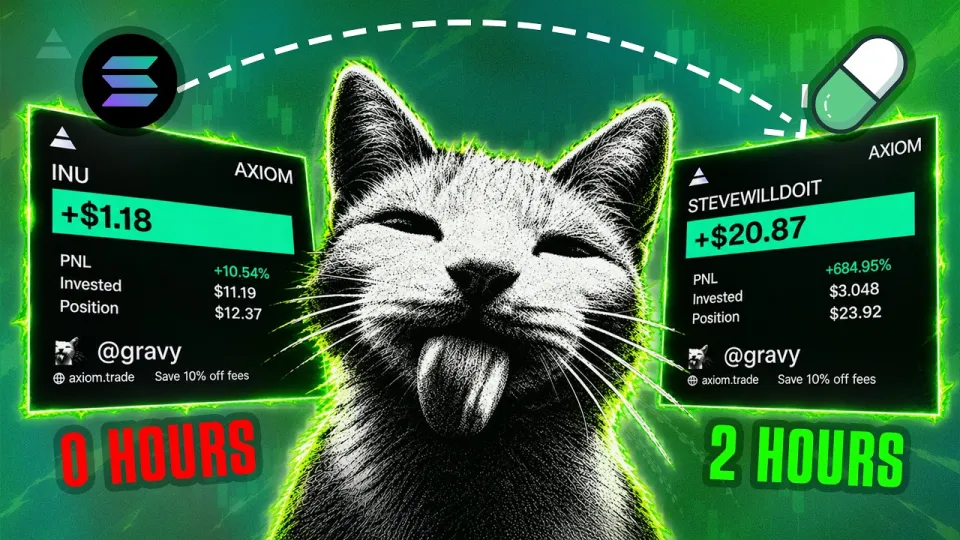
- STEVEWILLDOIT — an early narrative play built on a meme rather than a product. The lesson: entry speed matters more than analysis when the meta is fresh, and the exit is where most of the result is decided.
- NPC — a coin riding a broader internet-culture trend. The lesson: a recognizable name gets attention, but attention without liquidity is a trap.
- MET (Meteora) — a trade tied to an ecosystem name rather than a pure joke. The lesson: infrastructure-adjacent tickers attract a different, sometimes stickier, buyer base.
- PUMPY the Trader — a launchpad-ecosystem meme. The lesson: Pump.fun-adjacent narratives move in sympathy with the platform's own activity.
- UNTXD — the trade the creator admits fumbling badly. The lesson: hesitation and late exits cost more than bad entries in this market.
Why the X Money meta ran and how narratives get priced
The X Money coin meta is a case study in how a meme coin narrative gets discovered, priced and abandoned. The creator's explanation points to the e/acc (effective accelerationism) crowd and figures around the Cream ecosystem pushing the idea that payments inside X would create a cultural moment worth trading. Whether or not that thesis was correct, the market treated it as a reason to buy.
Narratives work like this: a story appears on X, a small group of accounts with reach repeat it, a token is launched on Pump.fun or an equivalent, and volume arrives before fundamentals ever could. For a trader with a small portfolio, the edge is not in reading every tweet — it is in recognizing which stories already have liquidity behind them and which are only being talked about.
Position sizing and fee discipline on Solana
Fee discipline is the single most underrated skill in low-balance meme coin trading. Every swap on Solana costs a base network fee plus whatever priority tip you attach, and the tip is what determines whether your transaction lands during a spike. On a $10 account, a generous tip can consume a meaningful share of your expected profit.
A workable routine looks like this:
- Set a hard maximum per buy — in the experiment it was 0.05 SOL — and never average down past it.
- Check the round-trip cost before entering: if your target gain is smaller than roughly two to three times the combined fees, skip the trade.
- Use a terminal that shows fees and slippage clearly before confirmation, and enable any cashback or fee-reduction program you qualify for.
- Take partial profits rather than waiting for a round number; small accounts rarely survive a full retrace.
Common doubts about trading meme coins with a small balance
The most frequent objection is that a small portfolio cannot overcome fees, and the experiment is a direct test of that claim. The honest conclusion is nuanced: fees do not make small trading impossible, but they make sloppy trading impossible to hide.
A second recurring doubt is narrative fatigue. Following every tweet, remembering which accounts have influence, and tracking community sentiment is genuinely overwhelming, and many traders report buying a dip only to watch everyone else sell and then seeing the coin run higher after they cut losses. The fix is to narrow the watchlist to a handful of narratives and accept missing most of them.
A third doubt is about consistency: how does anyone reliably find coins with good narratives? The answer from the experiment is process, not intuition — a fixed research feed, a fixed position size, and a fixed exit rule. Screenshots of wins are not a strategy; repeatable constraints are.
Useful links from the breakdown
- Axiom trading terminal with referral cashback — the execution platform used for all five trades.
- The Trenches Discord: https://discord.gg/W7TqkExcSd
- Free Axiom imports and trade signals (NFA): https://discord.gg/9W5j3XUgYB
- Creator's X account: https://x.com/gravyski
- Leverage trading with a 20% futures fee reduction: https://www.bitbase.com/landing-page/trading-earning-Gra?ref=8CYOGY
Conclusion
The $10 meme coin experiment does not prove that small accounts get rich; it proves that they can operate if position size, fees and narrative timing are treated as the strategy rather than the details. Five trades under 0.05 SOL each, one clear fumble, and a set of narratives that moved faster than the trader is a realistic picture of degen trading at this scale. The channel gravy is the author of this breakdown, and the natural next step it proposes is a live session starting from either 0.1 SOL or 1 SOL with a doxxed wallet. If you want to follow along or replicate the setup, start with a registration on Axiom via the referral link and keep your first buys as small as the experiment did.
Key takeaways
- The experiment: five real memecoin trades on Solana, none larger than 0.05 SOL per buy.
- Route: Axiom for execution and referral cashback, Pump.fun for early launches, X and Discord for narrative research.
- Every round trip costs fees and priority tips, so a $10 account has to size positions in a way that a 30–50% move still matters.
- Narratives (X Money meta, e/acc, Meteora, Pump.fun ecosystem) moved faster than the trader, and one trade was badly fumbled.
- The experimenter's open question: whether to live-trade from 0.1 SOL or 1 SOL with a doxxed wallet.
Questions & answers
Can you actually trade meme coins with only $10?
Yes, but the goal shifts from compounding to learning. With $10 you can take several sub-0.05 SOL positions on Solana, provided you account for network fees and priority tips before entering. Expect small absolute profits and treat each trade as practice in timing and exits.
How much do fees eat into a small meme coin portfolio?
Fees are a fixed cost per swap, so they hurt small positions proportionally more. A round trip includes the base network fee plus your priority tip, and on a $2–$5 position that can consume a large share of a modest gain. Checking the round-trip cost against your target profit before buying is the simplest defense.
How do you find meme coins with good narratives without drowning in Twitter?
Narrow your sources instead of widening them. Pick a small set of accounts and communities that consistently surface early narratives, watch which stories actually attract volume on-chain, and ignore the rest. Recognizing a narrative that already has liquidity behind it beats reading every post.
Why do small traders sell at a loss right before a coin runs?
Because position size and exit rules were never defined in advance. When a trade is sized so that a 30–40% drawdown feels unbearable, the exit is driven by emotion rather than plan. Fixed maximum position sizes and pre-set partial-profit levels remove most of that pressure.
Source: I Tried Trading Memecoins with Just $10 · Markdown version